From
San Diego Jewish World
Israel’s Consul General David Siegel presents $1,000 check to Tali Edid, Noah Villalobos and Vanessa Ramirez (Photos: Donald H. Harrison)
By Donald H. Harrison

Donald H. Harrison
LA JOLLA, California – It might have been a project on homelessness, or cleaning up the environment, or any other of a number of efforts by Jewish and Latino high school students to impact major social problems, but the project that caught the eye of the judges—and won a $1000 prize for three students to divide—was one envisioning teaching urban youth through YMCA’s and similar facilities how to grow and eat healthy foods.
Collecting a check on Sunday, June 1, for $1,000 from the Consulate General of Israel —were Tali Edid of the San Diego Jewish Academy, along with teammates Noah Villalobos and Vanessa Ramirez, who attend high schools in the Scripps Ranch and La Jolla areas. The presentations of the projects—and the later award of a check enlarged many times for photographic purposes—were given at UCSD’s Rady School of Management which has committed itself to develop ever more intense programs for social entrepreneurship.
In awarding the prize, Israel’s Los Angeles-based Consul General David Siegel told of the Jewish State’s interest in spreading the knowledge it has gained trying to solve large social problems and to likewise benefit from ideas developed in other nations.

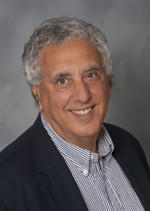
Dean Robert Sullivan, Rady School of Management
This particular program for high school students was co-sponsored by the regional offices of the Anti-Defamation League, which fosters inter-communal relations between Jews and other communities, and by the Spanish-speaking Ken Community Center, which provides a gathering place for Jews who have immigrated to San Diego from Mexico, Central America and South America. Tali, a 10th grader, was born in Mexico to a family with numerous relatives in Israel.
In developing their projects, the students were mentored by graduate students in MBA programs. High schoolers and mentors met two hours each Sunday, for five weeks, to develop their ideas, and to create power point presentations. The winning team now will work together with mentors for an additional six months in an effort to implement their ideas.
Siegel said that currently in Israel more than a half million college students receive scholarships and stipends to serve as mentors of high school students, so the program involves well over one million people. He added that Mexico has adopted the Israeli mentorship model and now offers similar incentives to students to become mentors at 61 universities and colleges throughout that nation.
Michael Sonduck, president and CEO of the Jewish Federation of San Diego County, told the students that “nothing important happens without collaboration.” He added, “whether it is Jewish-Latino collaboration, or MBA-High School collaboration, regardless of what it is, there isn’t an important issue that we face that doesn’t happen and won’t get solved without collaboration.”
Robert S. Sullivan, dean of the Rady School of Management, told the students that UCSD is forming a new center for social innovation, which will be headed by Ayelet Gneezy, an Israeli professor. In addition, he noted, over the last two years, UCSD has been operating a U.S.-Israel Center for Innovation and Economic Stability.

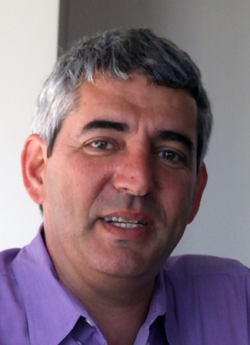
Uri Gneezy
An important question, Sullivan said, on “how do you go from ideas to doing something with ideas that have an impact on lives? ‘Economic sustainability’ literally means that over time that these ideas need to be sustainable solutions. They can’t just be great ideas that cost so much no one will ever do them.”
Over the long term, he said, UCSD will try to qualify as a “change maker campus,” that will be part of an international organization “in which the entire campus develops a responsibility, an intent, for dealing with these large social problems, that when you address them they make lives better.”
Along with certificates for their participation, the students were awarded a copy of The Why Axis, a book by Gneezy’s husband, Uri, who is an economist, and co-author John A. List. Uri Gneezy later gave the students a brief synopsis of some of the problem-solving work he is trying to accomplish.
He said non-profit agencies that try to resolve social problems are important contributors to society, but ordinary donors do not want to pay for those agencies’ overhead. Rather donors want their money to go directly to the cause, whatever it may be. Yet, if donors don’t wish to contribute to overhead, the non-profit agencies won’t be able to hire staff, and especially not at salaries that are competitive with those in private industries. How then, asked Uri Gneezy, can important non-profit agencies attract top-flight individuals to their ranks?
Gneezy answered that a study indicates donors don’t mind contributing to non-profit agencies, even with high overhead, if they know that their own individual contributions will in fact go to the project, not to salaries, or other overhead. So, he said, an apparent solution is to develop two streams of giving – one, from ordinary donors, that will be guaranteed to go for services; the other, from “rich guys,” government or foundations, that can, in fact, be used for overhead.

Participants in the Jewish-Latino, High School-MBA collaboration pose after receiving participation certificates